Thanks everybody so much for joining. My name is Janette Roush. I’m the SVP of Innovation and the Chief AI Officer for Brand USA, and this is the Agents of Change Webinar Series. And today’s webinar is a bit of a continuation actually from our previous webinar where we talked about creating your own personal operating system.
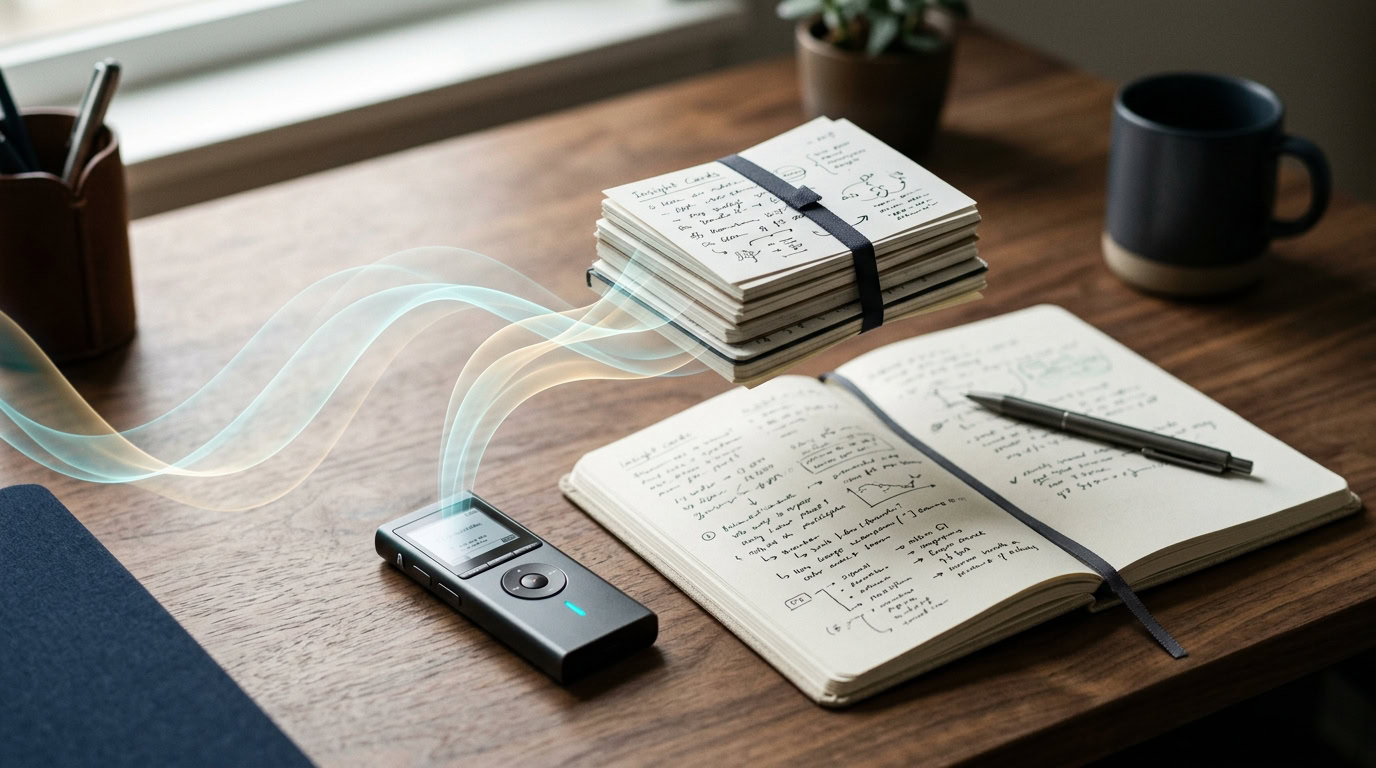
So this is from conversation to knowledge. How can you capture the information that you get at trade shows and conferences and from Zoom meetings and from in-person meetings? How can you capture those insights and use them in the future? And that’s what I’m going to walk you through today. So I think we’ve all had this experience, right, of being in a call or in a meeting and thinking, “Oh, here’s something I need to remember.”
And then before you know it, your desk is covered in Post-It notes. I used to be surrounded by notebooks and legal pads and little scratch pads, and every time I’d go to a conference, like all of us, I’d get a new notepad that I take notes in at that conference. And by the end of the week or the time that I get back home, I don’t remember what is worth saving, which thing with the stars by it. Is six stars important or is 17 stars important, right? And so my to-do list was always unfortunately a bit of a mess.
So the shift that I have made with working with AI is that most people are using AI, right? You’re using ChatGPT or Gemini or Claude as a chatbot, where you go in, you paste an email, or you paste something you need to have answered, and then you copy that and paste it somewhere else. The difference that I want to steer the industry towards is working inside of AI.
And so that’s the example I’m sharing today. The idea is that we want all of our calls to become a file because that file becomes knowledge that we can mine in the future. So the idea is that whether it’s at a conference or on your computer, you’re having the conversation, right? Just like you always would. You want to get a transcript of that conversation. You then want to make a note file on your computer, and then you want to create a way that you can get at that information from the note later without digging around on your computer looking for this literal note file, right? Because that’s going to be kind of beside the point if you have to figure out how to organize all of these notes on your computer manually.
So this system will create a wiki of your personal information that you can then use AI to access again. And the idea, like it says at the bottom here, you’re creating this loop so that every file that you add to your own personal intelligence system will make your next conversation better and smarter.
And I also want to share that we are working on ways of taking this idea at Brand USA and moving them from personal intelligence to company intelligence, but this will be purely for your own personal intelligence, which is why this is information that will live on your machine and not necessarily in a shared drive yet. So if you use SharePoint, if you use — we use Box at Brand USA. If you use Google Drive to store information, I think this concept could be extended to those external filing systems, but I’m not getting into that piece of it today.
So step one, we’re going to set this up once. Going to take 10 minutes, one-time setup, then we don’t have to deal with it in the future. So to begin, much like if you attended the personal operating system webinar, and that is currently live on our website at theBrandUSA.com if you want to catch up on it after the fact. But the idea is that you want to create one folder on your computer, and then you want to point Claude Cowork at that folder. So I’ll walk through how this could be extended to some other AI tools. I will say at Brand USA, we have a strong preference for Claude at this point in time because it is just the hardest working AI right now. Because it can read and write to files that live on your computer, that gives it utility that the other, more chatbot tools just don’t share.
So to start, if you haven’t created the entire personal operating system setup, you could just create a folder that is named My Notes, and that is the only thing that you need to do at this moment. So if you want to play along at home, on your computer, new folder, My Notes. You will see that there are four subfolders here. And if you’re using Claude, you can actually ask Claude Cowork to make these subfolders for you, so you don’t even have to make them yourself if you don’t want to. We have one that’s called Calls, one that’s called People, Companies, and Topics.
And again, to the point of which tool should you use, there’s two components to this workflow. One is taking a transcript and turning it into a call note, and then the second one is having AI read across all of your notes. So Claude Cowork or Claude Code is very good at doing both halves of this. So you can give a transcript to Claude Code. It will be able to read the entire transcript. It will be able to take your direction on what you’re looking for from your note summaries to write those summaries for you. It can then go back and retrieve the notes for you. It can save the notes in the place on your computer where you want to have them saved. So overall, the best tool for this.
The second component, or the second chatbot you could possibly use would be Gemini. So you can use a Gem, which is if you’ve created a custom GPT in ChatGPT or if you’ve created a skill in Claude. Gemini calls those Gems, and that’s just a repeatable workflow, a repeatable prompt. So wherever I talk about skills in this webinar, you can think of those as Gems and have Gemini write that as a Gem. Gemini could then save these. Instead of a folder on your desktop, Gemini is going to be integrated into your Google Workspace account, so you could actually create a notes file inside of your Google Drive and point Gemini at that file. I can’t swear that Gemini is actually going to do the saving of the files in the Google Drive for you though. So a little bit of this I have not spent as much time in Gemini trying to recreate this workflow. So certainly reach out to me after the webinar if you are a Gemini user, and I would love to explore how you are putting this workflow into place using the different tools.
And then the third place here would be OpenAI’s ChatGPT. So you can create a project in ChatGPT that can store all of your notes. You can use a custom GPT in order to read the notes and read the transcript of a call and make notes for you. But the retrieval process would only happen inside of this ChatGPT project, so it cannot read and write files on your computer without you uploading them to ChatGPT. So it’s not going to be able to do this entire workflow.
And like I said, a skill is just a saved prompt that you build one time. And I am going to show you three slides right after this with the skill that you could use in order to recreate the workflow I’m talking about. So if you’d like, you can just take screenshots of each of those slides, give it to Claude Cowork, and you can tell it, “Build this skill for me,” or, “Turn this into a repeatable prompt for me.” It’s going to then read the words on the screen and walk you through that process.
And again, there’s going to be two ways to build this inside of Claude. Now, I find that Cowork can be — like, I typically, I’m working with Claude Code, and I’m doing it inside of a tool called VS Code. So I find that skills work really reliably for me in that setup. And I find that with Cowork, certainly as we’re doing staff training here at Brand USA, and I am walking coworkers through setting up their own personal operating systems, sometimes Cowork will say, “Oh, I can’t write a skill for you,” or, “Skills are a…” You know, like it’ll argue with you about it. So Claude Cowork can absolutely read and write skills, so I don’t know why it is argumentative. That is just one of the quirks of working with generative AI. But I will say, the easiest path, give those screenshots to Claude or just say, “I want to build a skill with you that can track my calls and turn my calls into a personal wiki of information.” And Claude should walk you through the process and then save the skill for you. And it doesn’t require any programming. It doesn’t require anything other than you telling it, “I want you to save this skill.” But like I said, if that gives you an error, then you can paste in the file yourself. So you would make a folder inside of that — well, you actually should already have a Claude folder that has a skills file in it that you should be able to add this to as a skill.
And then this is the first of the three prompts that you would want to build. So again, a skill is just a set of instructions, right? So what we want to do is create a prompt that’s called Call, which turns a meeting transcript into a structured note. And then we also want this prompt, this skill, to keep my people folder, my companies folder, and my tasks up to date. And then it’s just saying in plain English what you want this prompt to do. So when I point you at a transcript, I want you to do all of these things. I want you to work from the verbatim transcript and not just the summary, because a summary can sometimes drop the decisions that were important to track. And I share that because I’ll walk through the tools that you can use in a little bit to collect these transcripts. Some of them make their own summaries. And there’s a variety of tools that I don’t even go into later. So some of them will make a summary for you. I find that system is more valuable if it is working from the full transcript and not just an AI-generated summary that is not generated by the Claude or the ChatGPT or the Gemini account that you use every day.
And then the first piece of it is what goes at the top of this file that it’s going to save for you. So it’s going to save all of these files in a language that is called Markdown. Markdown is a type of code that takes a plain text file and it tells somebody that reads code, like Claude, what the hierarchy of information is that it’s reading. So this note is written in Markdown. So we see here, like the double pound signs — that’s telling it this is a bullet point, right? This is something that I want you to collect in what they call front matter. They call it YAML front matter. I’m sure YAML stands for something. I don’t know what, and it doesn’t matter, right? So this is a little piece of code that is going to put at the top of every single call note that allows Claude or any AI tool to quickly read it and understand the information that it would find if it were to continue reading. And that’s important because these tools all have a limited amount of memory, a limited amount of context that they can hold in their brains at any one time. And so you don’t want it to read every time you’re looking for, “What did I say on that call two months ago?” and you don’t remember who was on the call or what the call was about. You don’t want Claude to read every single phone call note from the last two months. You want it to read just this little bit of YAML front matter to help narrow down where it should look more quickly.
Then the next instruction is it’s telling it to make a people Markdown file. So for every person on the call, it should look to see if you already have a file on this person. And if they don’t, then it should write a new file, and you should have a note that says, “Oh, this person, I’m going to make a wiki link to this particular call.” And that way, even if there’s one person who appears on multiple calls with you, but it’s a different group of people who are also on the call with the two of you, that person will still link out to every single one of these calls. And so that’s how — like, it’s just like how a human brain works, right? That we have neurons that fire and make connections. That’s what we want to create inside of this database that we’re building.
The third piece is companies. So again, it’s going to see if there’s an organization connected to the organization you were speaking with on this call. If there’s no organization, make one, and if there is, add this note that this call happened with them on this date. And then this is the final piece of the skill to take a screenshot of. We want to have tasks come out of this. So if there are any action items, turn it into a task that has an owner and a due date if one was mentioned. And then later, when I ask, “What’s on my task list?” gather all of the open tasks from across all of my notes. And again, because it’s written in this little piece of code at the top of these little Markdown files, it’s very fast for Claude to read through every single one of these notes and find the ones that have open tasks with the due date that you are looking for. And that is the piece where I no longer need Post-It notes all over my computer because if I have something come up that has a due date, I can just tell Claude, “Hey, would you make a task for this?” And it will automatically add it to my to-do list. And then every morning when I sit down at my computer, I open up Claude Code inside of VS Code. You may open up Claude Cowork and point it at your personal operating system, and you say, “What’s on my to-do list for today?” And it’s going to read through all of your task files to see what is — in my case, it looks at what’s due today, what’s overdue, what’s due later this week, so I’m not surprised when it comes up, and it’ll tell me what is due next week as well, if there’s a chance for me to get a jump on it.
And then the final piece of this skill is linking everything together with wiki links. So we want to connect the note from the call, the people on the call, the companies who are a part of the call, and topics with wiki links. So if a linked file doesn’t exist, you then need to create it. And then when you’re done, you can tell me in a little report what you filed, what you created, and if anything needs a decision from me. So it could say, “Oh, I realize that you talked about a new assignment, but nobody mentioned a due date. Do you want to add a due date to that now?” And that’s a way that you can train these tools to be proactive and get the information that it needs so that it can be as helpful to you as possible.
So that’s step one, which is setting up the architecture. And I’ll credit where credit’s due, that entire architecture was created by an AI scientist named Andrej Karpathy, and he has an entire — you can see webinars and interviews that he has given on this topic. He has a GitHub repo which has instructions for setting this up as well. So if you are familiar with GitHub and just wanted to plug into it, if you wanted to clone his repo and reproduce it, it’s going to be more advanced than the steps that I’m walking you through today. But he really popularized this idea of creating a second brain or an operating system for your personal AI that connects information together.
And then step two here, we want to start capturing information to put into it. So if it’s something that you said out loud or that somebody said out loud to you in a meeting, it should end up as text that you own, assuming that you are not violating confidentiality agreements by doing that. So there’s a few different ways for capturing this information. The first is for in-person meetings, I use a small recording device that is called Plaud, not to be confused with Claude, the AI system. All of these AI creators are absolutely terrible at naming things, and it infuriates me. So Plaud, the little recording pin, it comes with a cord so you can wear it around your neck, you can clip it to your collar, you can wear it on your wrist as a bracelet. So there’s a number of different ways to actually wear this wearable device. And it will connect — it’s a little clunky how the information actually gets to your computer. So when you get the Plaud pin, you also need to download an app to use it. Right now, the app only works on macOS. So if you are an Android user, you can’t use a Plaud device right now. But with that app on your phone, every time when you’re done recording a meeting or a session at a conference, you have to open up that app. You have to sync the Plaud device to the app. Then inside the app, you have to hit a button that says, “Yes, please, transcribe this meeting for me.” And then it will sync to a separate app that lives on your computer. And then once it gets into that app on your computer, you are able to download the file. So I’m sure there are other wearable devices. I could not name any for you right now, but if there’s not other devices, there certainly will be. So Plaud, if they own the market, they’re not going to own that market for long.
And this walks through that download process. So you’re recording the meeting on your device. You then download the transcript file from the app that is on your computer, and then you drop that into — physically, you are going to take the file and save it in your calls folder. Now I have written a connector for mine so that whenever I am done recording something, it will drop it automatically into a Google Drive folder, and then I can ask my Claude, my AI account, the LLM — I type in /plaud, so I actually made a skill for this, that will then go to that folder and pull out any new recordings and process them for me as a call note. So it is possible to be automated. You don’t have to automate it to get started. You can drag and drop the files.
Now, an alternative option, which is something that we’ve also started rolling out at Brand USA, is a tool called Granola. And Granola is purely an app, so it lives on your computer, and it’s an app on your phone. And you know what, I just told that whole story about Claude, and I’m actually not entirely sure if that was accurate because it’s Granola. I’ll have to clean this up in post, I guess. Granola does not have an app for your iPhone. Claude might. I actually don’t know the answer to that. Granola does not, and so you cannot use Granola on your phone if you have an Android device right now. But otherwise, Granola, that one piece aside, is like a really easy-to-use transcription device. So the sneaky part of Granola is that it doesn’t tell you when it’s joining a meeting. So if you are familiar with Fireflies or Otter or Read.ai, they will open up a black box, like they’re joining your Zoom call if they join the call. This silently joins, and so it becomes incumbent upon us to be transparent and to say when we are recording somebody on a call. But that piece aside, Granola is very easy to use. You can see here that there is a connector for Granola that is already part of the Claude ecosystem. So if you want to bring a transcript from Granola into a conversation, all you have to do is tell Claude in plain English, “Hey, look at Granola and get me the transcript from that call that I had yesterday with Brian.” And it can do that.
So rules around capturing. Always say you are recording. The laws vary by state and by country around what you are legally required to do. Like New York, where I’m located, is a one-party consent state for recording, which means if I’m the one recording and I consent to it, then I get to record. Which kind of sucks, right? So we don’t want to just rest on, “Oh, is this the legal thing that I can get away with?” You want to be transparent about the way that you’re using AI. Like that is our primary rule of thumb for AI use at Brand USA. You want to be transparent, and that may mean, in our guidelines around using the Granola recording device, make sure if you are in a meeting with your supervisor, if you are in a performance review, things like that, we actually don’t want to use a Granola recording device. Or if we do, we want to really explicitly talk about it in advance because people don’t like to feel like they’re being caught out by AI. That’s not a way to engender trust. And then the second piece is working from the full transcript, not the Granola summary of your conversation. And that connector that I showed you that Granola has, it will by default only pull in the one-paragraph summary that Granola gives you. But Granola doesn’t know you. Like, I wouldn’t necessarily trust what Granola summarizes as being all of the things that were important to you as the person that was on that phone call. So go ahead and ask it and explicitly say, “Make sure you pull in the entire transcript here.”
Then the third step for this process is we’re going to run it. We’re just going to do all of the filing by running one command. So this is a fake call transcript that I had generated for a previous webinar, where I used my demo DMO, which is Visit Beige County. And so I made some fake sales call transcripts for their convention sales team. So here we have a little excerpt from that fake transcript. We run the call command, which the way that I have mine set up — and you’re able to customize these commands. Like once you save the command in Claude, if you took those screenshots earlier, you’re not required to do it the way that I did it personally, right? Like what makes this so much fun is that you’re able to tweak it for the way you want to receive information. So you could go back in that command and say, “Actually, can you make a change to the call command and do it this way?” So here we have it set up so that I go into Claude and I invoke a skill by using the slash sign and then typing call, and that is how I pull up a skill that has been specifically named under that name. Claude is pretty smart, so it doesn’t really require you to be so specific to invoke a skill. You can just say typically, “Hey, can we process this call from Granola?” And it will most likely understand. You may need to remind it, but most of the time it will be, “Oh, that means that I should look to see if I have a skill that’s named call and then follow the instructions that are written in that skill.” And that skill can be written to say, “Hey, you have a Granola connector, so pull in from Granola the latest transcript that matches the topic that I think Janette’s trying to make a call about and use that transcript for the next steps in this process.”
And so here we see a little sample call note. So this is the YAML front matter. We have that it is a call. This is a wiki-linked Marcus Donnelly link. This is a wiki-linked Hartwell Pierce company. This is a wiki-linked topic for convention sales. And then we have decisions and action items. So decisions live in the note for the call. So you could go to Claude at some point in the future and say, “Did we decide anything yet about that Hartwell Pierce bid?” And it can use Hartwell Pierce as this interlinked wiki to go to the Hartwell Pierce company page and say, “Let’s look at all the calls that Hartwell Pierce was on.” And it could go through and say, “Oh, we do have decisions from that call,” and it will spit it back to you without you needing to read through a million different notes. And then you see Send Request List Today. So that would show up if you were to run your list of to-dos for today, that would show up on the list.
And then this is the note with the structure built in, right? So we have the metadata, which is who the call was with, all the wiki links. It’s already filled in for you. Claude writes all of this information for you. So you don’t have to ever know what YAML front matter is or how to write it. That’s on Claude to do. We have context, so it can save all of your quickie notes about this event, the decisions that were made, the action items and who owns that action item. If there were other things you want to capture, you just tell Claude you want to make an update to the skill, and then it will rewrite this prompt for you.
Every note’s going to link three ways. So it’s going to link to the people who are on the call, the companies that were on the call, and the topics that were discussed on the call. One reason I really like Granola for this process is that Granola can connect to your email, so that Granola will already bring in when you open up the Granola transcript. One minute before the meeting, it will pop up and say, “Would you like to start this meeting and open Granola at the same time?” So that it’s not going to automatically join a meeting without you knowing it, but it is going to remind you, “Hey, you have this great tool. Do you want to use it for this particular meeting?” And then when it writes the note, because it’s connected to your calendar, all of the information, the email addresses of everybody who is on the call will be connected back to the call note that Claude makes. It may need to ask you, “Oh, I didn’t have the full name for this person. I just had the first initial and the last name. Could you tell me what their full name is?” Sometimes Claude will get a little bit funny and will just invent a first name using that first initial. My Claude was doing that for a while, and I had to give it a rule to say, “You don’t get to just make up somebody’s name. Please ask me if you’re not sure,” or we could also just file it as M. Donnelly, N. Alvarez, if I don’t have time to fill in that information for you right off the bat.
So Claude, when you run the call skill, it’s going to create this file, and then it’s going to make all of these links so that, again, anytime you’re searching for something, it’s going to link back to this call automatically. And like I said, Claude can get things wrong, so you may want to go on your computer and actually open up these files to begin with to make sure that the links are all linked, that it captured everything you wanted it to capture. Like, that is just good call hygiene, to get into the habit of doing so that you’re sure that Claude is capturing everything that you want it to capture, and that eventually it will help you build that trust where you don’t need to keep the notebook with your notes alongside Claude, that Claude will eventually replace those notebooks.
And so step four here is how do I retrieve all of this good information that I am saving? And how can I do it when I need it using plain English, right? Because we’re not coders or data scientists here. I don’t want to write JavaScript in order to retrieve this stuff. So the idea is these files that we are building become your external brain. So every phone call creates a file about the person that you talked to. And then that file is then going to carry the history of your relationship.
So again — and we have a question that just came in that I can’t swear I’m going to be qualified to answer fully, but I’m curious about public records request laws. Are meeting transcripts subject to public record requests? And if so, do you keep call and meeting transcripts or delete them after a set amount of time? That is something I’m going to advise you to speak to your legal counsel about because even if I had a pat answer to that, it would vary by district and by state anyway. I think it’s quite likely that these would be subject to public record requests, which is something important to keep in mind in our new AI era is that even if your organization makes a hard line rule that you will never record a meeting, that doesn’t mean the people on the other end of the call aren’t recording the meeting because, like I said, it’s now possible to make that recording, and you have no idea that you are being recorded. So it’s a good rule of thumb probably for all of us to remember that information is much more findable than it ever used to be. And if there’s something that you shouldn’t be talking about in a meeting, don’t talk about it in the meeting. You should assume somebody is always recording you. And honestly, that’s even true in the public now, right? Because we have the Meta AI glasses. Like I said, the Plaud recording device. The Plaud device is somewhat obvious when you are using it. It has a light that turns on when it’s recording. You can’t really hide it anywhere or it’s not going to get a recording. But things like Meta glasses, people could use and be recording you and your voice and your face, and you would never know that you were being recorded. So we really are entering a time where, you know, you think about sunshine laws, there’s a lot of stuff that can get revealed that perhaps wouldn’t have been in the past. And so that is going to be a risk independent of your own company policy about using this stuff. So part of what we all need to do is get our ducks in line. Make sure that we are using compliant language when we are speaking, and that we don’t say or share information over a Zoom that we wouldn’t say or share over an email or in any other context.
So back to each person carrying their whole history. This is going to be your personal notes based on these conversations of the things that you are selecting and that Claude is selecting to save about this person. And I think again, particularly through the lens of sunshine laws, take a look at these notes before Claude saves them for you. So you want to keep the person in the loop, and if there’s something that Claude’s trying to save that you’re like, “Nope, that is irrelevant,” or, “I don’t think that’s a really good idea to save that piece of information,” delete it out or tell Claude to delete it. And that will make for a better system moving forward anyway because these tools are only going to be as good as the information that lives in them.
And then what this allows you to do is things like prep for future phone calls. So if I ask Claude, “Prep me for my next call with Marcus,” it’s going to look to see, like it says here, where we left off in our last conversation, what items I owe Marcus, who else was in that previous meeting, if there were any open questions from the last meeting that we had. And very quickly you can get brought up to date. I mean, I will tell you, I was the biggest note-taker and the worst person at being able to find any of those old notes. So now everything that was your personal scratch pad in the past is all very easy for Claude to pull in. And you can start to see how this kind of information could compound in the future.
So if I had a meeting with Marcus and I say, “Prep me for my next call with Marcus,” but I have Outlook connected to Claude, then it can also — maybe I don’t have to ask it to prep me. Maybe it sees my meeting with Marcus on my calendar and it preps me just as part of my daily briefing that I get every morning. And I will tell you, that is how I have my Claude set up. Maybe if it is for a larger event that you’re attending and Marcus is one of the attendees, maybe you have a connector to your CRM. And so not only are you looking at your own personal scratch pad about your conversations with Marcus, but it can go into your CRM and pull back information like your actual canonical company information about your relationship with Marcus and what you need to know going into this next meeting. So this is — like, I see these AI tools in the future really becoming the hub for where we do work. So instead of logging into 20 different SaaS platforms, those platforms get connected to your AI account, and the AI goes out and does the research and brings back the information, and you get it all in one place without hunting around for it.
So something else that you could then do with this type of information is start to track the work that you are doing. So you have a month’s worth of sales phone calls and the head of sales wants an update from you on what you’ve personally been doing. Like, yes, I’m sure there are reports that can be pulled out of Salesforce or Simpleview or whatever the CRM that you’re using in order to generate that report. Or maybe it could happen more quickly or with a bit more personal nuance if you are pulling that report from your own personal notes about where things stand.
This system, then, starting to see where else this becomes useful, it can start drafting those emails for you for those next steps. So I have a skill in Claude that is called Janette Voice, and that skill was built by reading 100 emails that I had sent. So it is not perfect. And I am not trying to trick anybody into thinking that Janette wrote something that Claude really wrote. Typically, the way that I use that is I will get that head start from Claude to write the email, and then I will put in additional information. Or if there’s a really succinct middle paragraph, what I like to do is say, “Oh, it was so great to see you on the call,” et cetera, et cetera. “Here’s what Claude told me to update you on.” And that way I am being completely transparent about my use of AI and how it’s not only writing for me, but compiling information and helping me track a project, using Claude. And I like to do that because in my role, it’s also a teaching opportunity. It’s a way to share these are more ways that you can be using Claude, because we don’t want to just settle for AI as a fancy email rewriting machine, but it can do so much more than that.
And then this is the part of the process where the AI can start to remind you of all of those things that you say you are going to do on those calls. So I have a skill called Today, which will look at my calendar and tell me what meetings I have coming up. It will look at all of those notes, and it will find the YAML front matter that says what I have due today. And then it gives me a report of everything that I need to get done today. And if I didn’t do it, it shows up again, and then it shows up in my overdue list, which I’m embarrassed to say is still very long. So AI can help you do a lot, but sometimes you still just have to actually do the work.
And I’ll share one final use case for where this tool becomes very cool, and that is from attending conferences. And I know for the DMOs on the call, we have a couple of big conferences coming up this summer, right? And if you’re in leadership and you are the one sending people to conferences, you want to make sure that the entire organization benefits from what that one or two people in the room were actually learning. So how can we do that? Record those sessions at the conference. So this is a fake example. I gave Claude a link to the agenda for Destinations International Annual Convention, and I said, “Look at all of the AI talks that are happening, and then make a fake summary of what you learned at those talks.” So this is something that I have started doing for the conferences that I attend, in part because it’s hard for me to remember what I’ve learned at these conferences. And I take pages upon pages of notes in the past, and then at what point are you actually going back and reading through the notes so that you can report up to your boss what did you learn or share with your direct reports these are the things you need to be thinking about? And even if you did that, are you retyping it from your handwritten notes into a plain text email? The thing about email is just words is not always the best way to take in information, right? There is a reason why we like to look at websites and PowerPoint decks. It’s because good design makes it easier to understand information. So we have another skill at Brand USA that will implement our design philosophy into the documents that we create. So one is a PowerPoint design skill, but we could also just, in this example it’s an HTML page that Claude then made a screenshot of to put into this PowerPoint. And it’s just an HTML page that uses our colors and our fonts and our layout. And you can see that if this were real, it’d be much easier for somebody to digest the information from this conference than if you just wrote up a Word document or a long email with all of your takeaways.
And again, it’s the time that it takes, it’s about 10 minutes. It takes as long as for you to drag and drop your Plaud files into Claude and say, “Hey, maybe we don’t process this as a call.” You know, maybe you want to tweak that call prompt. I have one that’s called Conference, and it will go through — and it’s now like a multi-step thing that I have automated, but it will read through all of the notes. It will pull out what it thinks are the most important talking points. It knows that for me, it’s not going to be everything, it’s going to be as it relates to AI and AI adoption in the office and AI adoption across the industry, and how can we use AI to make the United States more discoverable and more bookable, whether in AI platforms or using AI as a tool to get there. And so it’s looking specifically for information from the conference or from those sessions that relate back to what I care about, and then it will put those into an HTML file for me to review, and then I can ask it to turn that HTML into a PowerPoint, and then I will get back a PowerPoint that I can share with interested parties across the company. And so it is a really great tactic to make sure that all of the information at a conference doesn’t die the second that you get back on the plane back home.
And then the final step here, how are we making this system work for you? You’re going to have one file that sets out all of the rules. This is your CLAUDE.md file. And again, if you joined the webinar that we had last week on setting up your personal operating system, that webinar is now live at theBrandUSA.com, so you can re-watch it there if you would like. But the CLAUDE.md file is if you point Claude at a folder on your computer, even if you just set up this one folder that is named notes, and it has those four subfolders in it that we had at the very beginning of this conversation. You can then tell Claude to write this for you and to save it in the folder for you. So you don’t have to write this, but you could also screenshot this and give it to Claude as you are setting up this project. And it’s just a set of instructions for Claude. “This is how I file calls. This is where the notes go. This is what I want the name of every single file to be. I want people, companies, and topics to always be linked. I want you to always work from the full transcript.” And this is a good point, recorders do a terrible job of knowing names of people unless it is Granola attached to a specific calendar invite in your calendar. So ask it to confirm those names before it files anything. And then when it gets something wrong, tell it that it got something wrong and how to fix it. So like here, it can add a note if it keeps fixing the spelling of a name, it’s like, “Okay, great. Now I’ve added to your CLAUDE.md file to always double-check those names against your people files before making a new file.” And here it saved it to CLAUDE.md so that it’ll apply to every single call moving forward.
You can even ask it to coach you after calls. This is a coaching tip that it gave me when I asked it for call coaching based on a number of transcripts that it had in the system. And it’s like, “You’re leaking the most value after the call because here are the kinds of things you are not following up on.” Like, that’s good to know. And you know what I did? I went and I tightened up that feedback loop so that I am capturing more tasks out of the calls because when I first set this up, I don’t think I had the task piece of the workflow set up quite the way that I’m talking about it today. So that’s, again, an important component of what we are doing here.
So if you want to get started this week, you want to get a paid AI tool, please. If you do not have a paid AI tool yet, now is the time to make that happen at your organization. I have, as you have picked up on, a big preference for Claude. But whether it’s ChatGPT, Gemini, even Copilot, if that is all you can get access to, a paid tool keeps your data safe. It keeps the companies from training future versions of AI on every call transcript that you put into it. You then want to come up with a recording system. So I happen to have two. I use both Granola and my little Plaud pen. One of the things I like about the Plaud, the separate physical recording device, is when I’m doing a keynote at a conference, I will record what I do using that pen, and then I will use AI to interview me after I’m done with the keynote to figure out what could I have improved, and did the slides that Claude and I built together — were there slides, could there have been more slides added where I talked for a long time, and I could have used the visual backup for something? I will also then use the transcript of my talk to make a website that is a customized takeaway for the people at the conference, so that they can go back and see an outline of everything that I talked about. So if you’re not using it right to that level, honestly, I think Granola is a great solution because you can still record in-person meetings and conferences with Granola. You just have to have the app open on your phone, assuming that it’s an iPhone, and you can set it to record. And the reports that I have heard from the field is that it is pretty reliable for that process.
And then step three here, just start trying it. For your next call, record the call, set up this whole call skill, and then run the skill on the transcript. Watch it file in real time, and then you start to make this self-improving loop. It won’t be valuable right out of the gate. I started using this in January, and it probably took a couple of months before I was really seeing the benefits of, oh, this topic that I talk about every couple of weeks on a call, it’s now starting to build more context around the topic or around the conversation with this one particular person. So it takes time. Just like Wikipedia, if it only had three entries, who cares, right? You need to have kind of a corpus of knowledge for the tool to become really valuable for you.
But I will say another way that I am using this tool right now is if I’m — like, I’m going to a dinner on Thursday. I have a separate workflow set up where I share a list of the attendees with Claude, and I say, “Check to see if any of these attendees are in our Salesforce. Check to see if any of them I’ve had previous calls with or with anybody from their company. If neither, then do a quick internet search on them, and then make a little HTML site so I can have it up on my phone when I am at the dinner that has, if you can find it, a picture of the attendee, a link to their LinkedIn account, a little bio, name, company, what’s their job title, what do they do there, if that can be discovered. And then what could this person and I talk about, right? Where do we intersect, and where could we provide value to each other?” And I will say this tool is an amazing icebreaker. I had it redesigned to look like tarot cards a little bit. And so when I go to an event and I’m like, “Oh, look at what AI said about you.” Like, people will take your phone from you and start passing it around, right? Because of course, we all want to see what AI has to say about us. But of course, you don’t have to do that, right? If it’s not safe for sharing, just don’t tell the people that that’s what you did. But it is a really fun way to do conference prep.
So to close us out, and please, if you have any questions, go ahead and put them in the chat because we still have a couple of more minutes. I hope you will join for our next webinar, Ditch the Deck. I may actually need to retitle this a little bit, right — how I’m using Claude to build presentations. The original title’s like I’ve ditched PowerPoint and I’m all HTML now. That was a few months ago when I wrote the description for the webinar, that was the case. I have now found that Claude is such an excellent thought partner at helping me create. I’m doing a new presentation from scratch every time I do one of these webinars, and it would never happen if I was literally opening up a blank PowerPoint and trying to figure out what to put into it. Now it’s a conversation that I have with Claude that turns into these decks, and so that’s the process that I want to share on August 3rd, as part of the next webinar in this series. And yes, a recording of this webinar is going to be available on our website. So this is also where you would go to register for any of our upcoming webinars, so theBrandUSA.com/events/webinars in order to join.
And with that, I want you to think about what will your first workflow be? So I want to thank everybody very much for their time today, and I look forward to seeing you at the next Agents of Change webinar series. Have a great afternoon.