
Millions Expected to See Rare Eclipse Crossing the U.S. in August
Mark your calendars for August 21, 2017 and start making your plans to be in the right place in the United States that day for an extraordinary celestial event – a total solar eclipse tracing a path across fourteen states.
On that day, millions of people across the United States will witness a true natural wonder – a total eclipse of the sun. The moon will completely block the sun, turning daytime into a dark twilight in the middle of the afternoon.
Rare? Absolutely! It will be the first total solar eclipse to make a transcontinental path across the United States since 1918 - 99 years ago, according to the National Aeronautics and Space Administration (NASA). The last total solar eclipse was only visible from five northwestern states in February 1979.
The track of the eclipse – called the path of totality – will travel right across the United States, making it visible to hundreds of millions of Americans and visiting travelers. The eclipse will begin at the Pacific Ocean at sunrise and cross Oregon, Idaho, Montana, Wyoming, Nebraska, Iowa, Kansas, Missouri, Illinois, Kentucky, Tennessee, Georgia, North Carolina before ending in South Carolina. According to NASA, over 500 million people will be able to observe this solar eclipse, in partial or total form - 391 million in the United States, 35 million in Canada, and 119 million in Mexico (plus Central America and parts of South America and northwestern Europe).
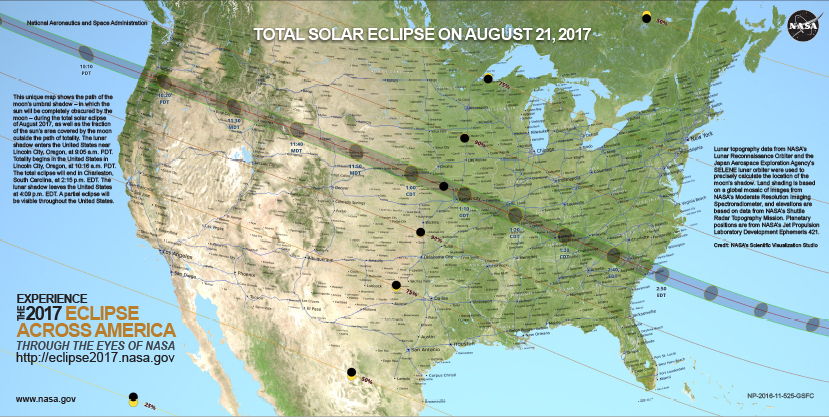
NASA offers a website that provides everything from Eclipse 101 to activities and education to how to have an eclipse parties. Visit https://eclipse2017.nasa.gov/
The length of the eclipse and time of occurrence will vary, depending where viewers are located along the path of totality. In each location, however, the sky gradually will darken and reach a total eclipse. Daytime will seem like twilight. The extremely rare “corona” effect around the sun, visible only during a 100 percent total solar eclipse, will be observable. Nocturnal animals will come out for their nighttime activities only to see the sun emerge again.
Many areas along the eclipse path are staging events to coincide with this magnificent celestial event.
NASA is compiling a list of events along the path of the eclipse, offering a myriad of locations and activities to entice curious domestic and international visitors interested in viewing the unique event. For more information on the events, see: https://sdo.gsfc.nasa.gov/.
There are scores of locations to view the eclipse. Consider Columbia, S.C. which will host a long weekend of eclipse events from Aug. 18-21. With the expected influx of travelers from Europe, regional leaders have been developing a wide array of attractions leading up to the eclipse. Columbia will see the longest totality for a metropolitan area on the East Coast – two minutes and 36 seconds. To view the events, visit http://www.totaleclipsecolumbiasc.com
"Because of its unique location on the center line of totality during the first total eclipse in the continental U.S. in 38 years, the greater Columbia, S.C., area is incredibly lucky, geographically speaking," explained Merritt McNeely, chair of the Total Eclipse Weekend Columbia, S.C. initiative. "Because of this, we saw the need to come together as a region to offer a weekend full of activities for people of all ages to celebrate this amazing phenomenon."
"The cultural offerings during the eclipse weekend will be vast and plenty, leaving lasting memories for those who attend,” McNeely said. “Our hope is that we impact those who are with us and also leave a legacy of art, music, dance, culinary experiences, educational opportunities and more during this once-in-a-lifetime event."
Nashville, Tenn., holds the designation as the largest city located within the path of the total solar eclipse. The Music City will have its share of events surrounding the eclipse. Nearby, Clarksville, Tenn., will see a total of two minutes and 19 seconds of eclipse totality, while Nashville will see one minute and 57 seconds.
Others prime locations along the path include: Salem Oregon; Grand Teton National Park and Jackson Hole, Wyoming; Idaho Falls, Idaho; St. Joseph, Missouri; Carbondale, Ill.; Paducah KY.
Other events include:
- The Great Smoky Mountains National Park will offer majestic panoramic locations to view the eclipse. The park is currently planning organized public viewing events at three locations in the park: Clingmans Dome; Cades Cove; and Oconaluftee. For more information, visit https://www.nps.gov/grsm/planyourvisit/2017-solar-eclipse.htm
- A Family Solar Eclipse event will be held at Yellowstone National Park.
- The Museum of Idaho in Idaho Falls is teaming up with NASA and The Jet Propulsion Laboratory (JPL) for a four-day series of events.
- The Blue Ridge Mountains of South Carolina will hold a weekend of events. Visit the science center, observatory and watch the eclipse from a Girl Scout Camp on the centerline.
- The Salem-Keizer Volcanoes, a minor league baseball team in Keizer, Oregon are planning a four-day "Eclipsefest.” There will be an “eclipse delay” during the baseball game – the first ever in baseball history. The team has partnered with a sponsor to provide eclipse viewing glasses.
- A city fair will be held in Hopkinsville, Kentucky surrounding the eclipse, which will be visible there for two minutes and 41 seconds.
Two other websites offering information on the eclipse and best viewing areas in each state are:
NASA warns viewers need special glasses, a pinhole projection box or special filters for a telescope to safely view a solar eclipse. Only during the few minutes of totality is it safe to look at the sun without protecting your eyes.
Potential viewers should not look directly at the sun when any part of the sun remains visible unless they are wearing ISO-approved eclipse viewing glasses. According to NASA, only three manufacturers have certified that their eclipse glasses and hand-held solar viewers meet the ISO 12312-2 international standards for such products: Rainbow Symphony, American Paper Optics, and Thousand Oaks Optical.