
Hartford's Literary Legacy-Mark Twain, Harriet Beecher Stowe, and Wallace Stevens | Journeys, Jaunts and Junkets
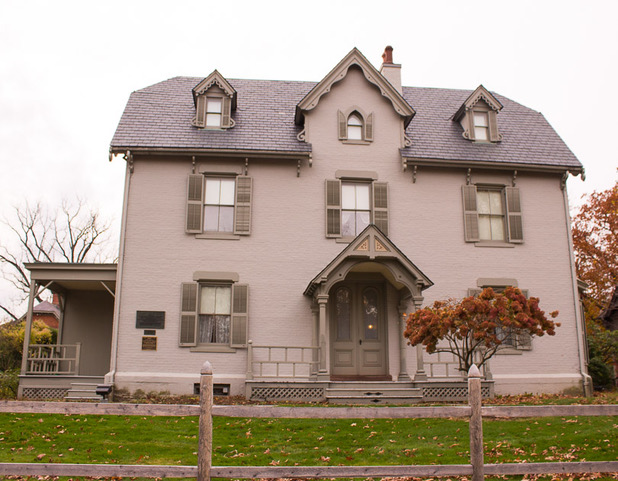
Groupies come in all shapes and sizes. Some follow bands around a festival circuit. Others hit the streets of LA, trying to get a glimpse of a favorite movie star. My friends and I are groupies too, only we choose to follow our literary heroes. It started at a writing retreat two years ago. When the week concluded, we agreed to keep our bond active by meeting at least once every year. Ladies Literary Road Trip to Hartford, Connecticut We wanted to choose destinations where we could combine work on our writing projects and visits to the homes of writers we’ve admired. We dubbed it the Ladies’ Literary Road Trip. For the inaugural destination, we chose Hartford, Connecticut. Hartford was one of the wealthiest cities in the United States for decades following the Civil War. The prosperity attracted a famous and influential group of activists, artists, and leaders of industry to the area. Hartford’s nickname “The Insurance Capital of the World” remains true today as it continues to be the headquarters for several major insurance companies. Our trip to Hartford would allow for visits to the homes of two writers whose career defined America, Mark Twain, and Harriet Beecher Stowe, and a walk in the footsteps of Pulitzer Prize-winning poet Wallace Stevens. Mark Twain Samuel Clemens led an exciting life growing up along the Mississippi River in Hannibal, Missouri. He left home for New York at the age of 18 to set out on his own, setting type for a local newspaper. It was during this time that Samuel became a writer. Later, he traveled out West and wrote short stories that garnered him fame and further assignments under the pen name Mark Twain. One paper offered him an opportunity to travel abroad to write about his experiences. While traveling, he met his future brother-in-law Charles Langdon. During their trip, Langdon showed Samuel a picture of his family, including his sister Olivia. Samuel fell in love at first sight. After courting Olivia for two years, they married and later settled as renters in the exclusive Nook Farm neighborhood in Hartford, Connecticut. Nook Farm was home to very prominent neighbors, including activist and suffragist Isabella Beecher Hooker and author/activist Harriet Beecher Stowe. Nook Farm, An Exclusive Place to Live The Clemens purchased a few acres in Nook Farm and built their dream mansion designed by architect Edward Tuckerman Potter. Completed in 1874, the 25-room home consisted of three floors. Its interior measured 11,550 square feet. The house was built with the most modern amenities of the time, including 7 bathrooms with indoor plumbing and gas lighting. Around 1881, the public spaces were lavishly decorated by Louis C Tiffany and Co., whose designs included influences from India, China, Japan, Morocco, and Turkey. The Clemens family lived in the home for 17 years, which were the happiest and most prolific for Samuel Clemens. He completed five of his famous novels there: The Adventures of Tom Sawyer, Life on the Mississippi, The Prince and the Pauper, A Connecticut Yankee in King Arthur’s Court, and Adventures of Huckleberry Finn. Visitors can learn all about the Clemens family, see the desk, and the room where Samuel wrote his masterpieces and set eyes on original artwork and period furniture pieces throughout their historic home. Purchase tickets at the Mark Twain House and Museum Center or by visiting the website – www.marktwainhouse.org. The tours are fascinating and offer a window into the life of this beloved storyteller. Harriet Beecher Stowe Across the lawn from the Clemens mansion lived writer and abolitionist Harriet Beecher Stowe, who was born in 1811to the prominent Beecher family. Reverend Beecher believed that ministry was the most effective way to influence society and encouraged his 11 children to make a difference. Harriet found that her calling was writing. After receiving formal education at Sarah Pierce's Academy, she became a teacher and essayist at Hartford Female Seminary, the school founded by her sister Catharine. At 21, Harriet moved with her father to Cincinnati, Ohio. She met Calvin Stowe. They married while living in Cincinnati. During her time in Cincinnati, she witnessed slave auctions where small children were torn away from their mothers and sold. The horrifying images stuck with her. After the death of her own child, Samuel Charles Stowe, at 18 months from cholera, the pain she felt led her to connect with the agony of enslaved women whose babies were sold. The experience became the inspiration for her novel, Uncle Tom’s Cabin, whose origins began as a newspaper column in The National Era, an abolitionist newspaper. The installments became her 40-chapter anti-slavery novel. This led to a conversation about abolition with President Lincoln. After Calvin's retirement, the Stowe's moved to Hartford, Connecticut, to Nook Farm, where her sister, Isabella Beecher Hooker, was a resident and well-known activist in the suffragette movement. Harriet built her dream home, Oakholm. She sold it in 1870 to move to the more manageable gothic Victorian cottage at 73 Forest Street with her husband and her two adult daughters and lived there for 23 years until her death in 1896. A visit to the Stowe Center is not just a house tour. You will tour the home and see her paintings and rooms decorated with family photographs, heirlooms, and a first edition copy of Uncle Tom’s Cabin. You will also enjoy an interactive experience with your guide. The tour includes discussions of 19th-century social issues such as slavery and the role of women. The Stowe Center is a hub for social justice topics. It offers visitors fruitful discussion around the issues that continue to resonate today. The Mark Twain House and The Harriet Beecher Stowe House (also National Historic Landmarks) can be seen on the same day. Bring your receipt from either tour to receive a discount to the other site. Visit www.harrietbeecherstowecenter.org for ticket prices and hours of operation. Wallace Stevens Stevens never learned to drive. A Harvard educated man who attended law school and later became an executive at the Hartford Accident and Indemnity Company was also an essential American Modernist poet. He walked to his job at 690 Asylum Avenue and back to his home at 118 Westerly Terrace in Hartford, Connecticut, composing his poetry along the way. To follow in the Pulitzer Prize-winning poet's footsteps, trace his steps by reading one of his famous works, “Thirteen Ways of Looking at a Blackbird,” inscribed on thirteen Connecticut granite stones that marked his daily commute. Hartford, Connecticut, is worth a trip to connect with the literary heroes who shape our views of America and whose work is still important today. There are so many other attractions that offer plenty to see and do. For more information about the city, visit www.ctvisit.com. Jeanine ConsoliJeanine Consoli is a freelance travel writer, photographer, and foodie based in Washington Crossing, PA. A retired elementary school teacher, she used her summers to feed her passion for travel and kept journals of all the destinations she explored. Today, Jeanine is working as a writer full-time. She loves uncovering the history and understanding the culture of each location, including the local flavors of each particular place. She has traveled extensively in the United States and Europe and is excited to keep adding to the list, finding unique sites that are off the beaten path both at home and abroad.